Andrew Finlayson is a writer, public service leader, and digital transformation specialist. To colleagues, friends, and people who come to know him well, he is simply Finny. His work explores responsibility, performance, resilience, human potential, and the practical realities of leadership in modern life.
Books and Writing Themes
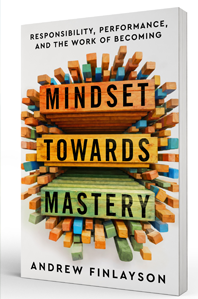
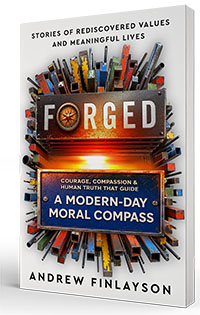
He is the author of Mindset Towards Mastery: Responsibility, Performance, and the Work of Becoming, a leadership book for readers who want to grow with purpose, focus, and integrity. He is also the author of Forged: A Modern-Day Moral Compass, a companion work shaped around real human stories of adversity, care, courage, identity, and moral clarity.
Career and Professional Background
His career spans more than 35 years across hospitality, software training, entrepreneurship, technology leadership, health and life sciences, global consulting, and public service transformation. He began his working life in Blackpool, in hospitality roles including chef, waiter, and cleaner, before moving into software training and technology. He later founded and sold a training business, led digital programmes for major organisations, and moved into senior leadership roles across health, life sciences, and public services.
He has worked across multiple sectors and countries, supporting organisations through change, digital transformation, people development, and leadership challenges. His experience includes leading technology teams, delivering large-scale digital platforms, shaping innovation programmes, and working with public service clients on complex transformation.
Keynotes, Futurism, and Research
He has presented around the world and delivered keynote talks in Hong Kong, Singapore, Turkey, Germany, Belgium, France, the UK, and the United States. His talks have explored the future of healthcare, technology innovation, trust, and citizen engagement.
Futurism is a common thread across this work. His presentations have been grounded in long-form research on topics including medical devices, digital clinical trials, digital marketing, commerce trends, and safety through regulatory policy change. This combination of research, technology, policy, and human consequence continues to shape how he writes about leadership, systems, responsibility, and change.
A Lifetime of Practical Writing
Finny has been writing professionally since the early 1990s. Before writing books, he wrote training courses, business materials, executive reports, proposals, specifications, long-form articles, and thought leadership. His earliest writing was practical and instructional, including a substantial library of computer-training courses for learners.
These materials were used by public sector organisations, councils, local businesses, community-based learners, farmers, accountants, travel agents, hotel reception staff, and commercial teams. The courses were written for different levels of experience, from introductory users to more advanced learners, and were designed around a simple principle: people learn best when they can apply knowledge immediately.
Training, Technology, and Business Writing
His training and technology writing covered two connected areas: practical learning materials for people developing digital confidence, and professional business writing for organisations navigating technical change.
His written outputs included:
- Course notes, exercises, user guides, training manuals, and practical learning materials that helped people learn by doing, rather than simply reading theory
- Business proposals, client reports, technical specifications, application architectures, executive summaries, clinical research materials, and enterprise transformation documentation that helped organisations explain, justify, and deliver complex change
- Public sector training materials, NHS training content, council systems guidance, local business support materials, and community technology learning resources designed for people working in real operational environments
The technology and software areas included:
- Microsoft Office, Windows, DOS, and PC fundamentals, helping technical support staff and everyday users build confidence with core workplace technology
- Microsoft Word, WordPerfect, and Microsoft Works, helping people write letters, reports, forms, procedures, and business communications more clearly and efficiently
- Microsoft Excel and Lotus 1-2-3, helping users build spreadsheets, work with formulas, analyse information, and produce financial or operational reports
- Microsoft Access, DataEase, Approach, Microsoft SQL, MySQL, and Oracle SQL, helping learners understand database design, data management, reporting, and business information systems
- PowerPoint, Freelance, PageMaker, InDesign, CorelDraw, and Photoshop, helping teams create presentations, publications, visual communications, marketing materials, and large-scale design outputs
- 3D Studio Max, Premiere, SoundForge, and Macromedia Flash, helping creative and technical users develop multimedia, animation, video, sound, and interactive content
- PHP, Pascal, COBOL, and Visual Basic, helping learners understand programming logic, application development, legacy systems, and practical software creation
Learning Across Disciplines
The range is unusual. It spans everyday office tools, legacy systems, databases, publishing, multimedia, programming, clinical research, and enterprise transformation. That breadth reflects the shape of a career and also how he learns. His neurodiversity has often drawn him towards pattern recognition, practical experimentation, and connecting ideas across fields that are usually kept apart. Rather than specialising in one narrow lane, he learned by building bridges between tools, people, systems, and outcomes.
Continuing to Learn
That learning continues. He now works with emerging technologies, including artificial intelligence, large language models, machine learning, advanced data systems, multimodal models, knowledge systems, automation, video creativity, digital content tools, and generative media. He uses platforms and tools such as Claude, OpenAI, Jasper, and other creative and analytical systems to understand how technology is changing writing, learning, leadership, communication, and decision-making. His interest is not only in what these tools can produce, but in how they change the way people think, work, collaborate, and make sense of complex information.
From Practical Writing to Human Consequences
That writing history shaped the accessible, practical style behind his books. His work has always been concerned with helping people understand complex ideas, build confidence, and apply learning in real situations. He did not come to writing through a conventional academic route. For many years, writing was simply part of the work: a way to teach, explain, persuade, document, and help people do their jobs more effectively. That changed as his career moved deeper into Life Sciences, where he saw the human impact of research, health systems, clinical work, and technology. Writing became more than a professional tool. It became a way to connect practical knowledge with human consequences.
Writing Purpose
His writing brings together professional experience, practical leadership insight, and a strong belief that systems work best when they remain human. Across Mindset Towards Mastery and Forged, he writes about the choices, pressures, relationships, and responsibilities that shape how people lead, recover, grow, and become.
Themes and Areas of Interest
He speaks on themes connected to leadership, technology, trust, public service, and human-centred change. Popular topics include:
- Responsible Leadership in the Age of AI
- The Future of Healthcare and Digital Transformation
- Trust, Citizen Engagement, and the Future of Public Services
- Human-Centred Technology Innovation
- Digital Inclusion, Social Mobility, and Opportunity
- Resilience, Well-Being, and Sustainable Performance
Enquiries
For media enquiries regarding the books, he can be contacted via this website. For other professional contact, LinkedIn is best.